

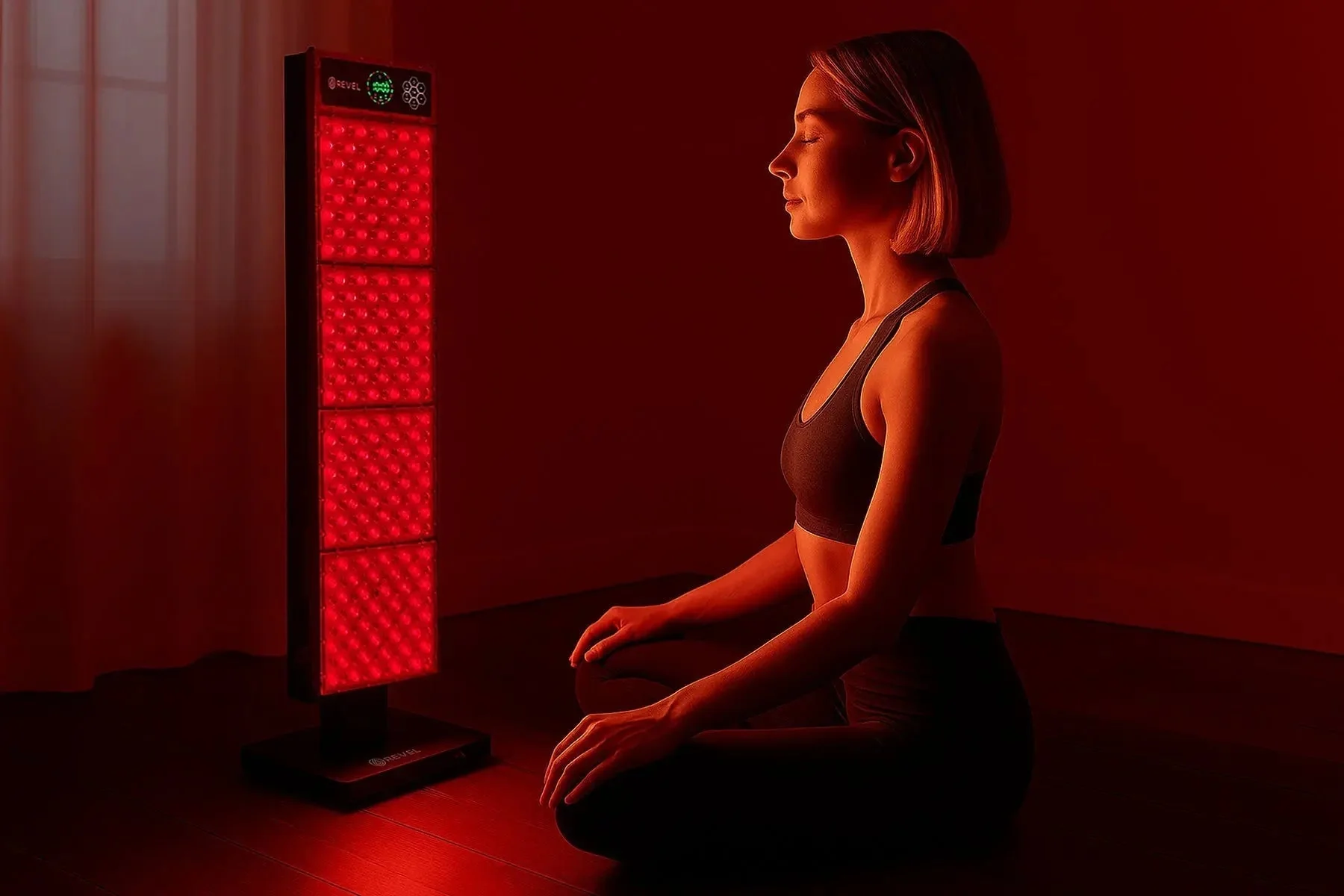
A red light therapy lamp is not just an LED source with a red hue. The difference is determined by wavelengths, the irradiance value, the beam angle, the panel size, and the actual dose at the skin surface. These are precisely the parameters that distinguish a targeted photobiomodulation tool from a weak household device.
How does a therapeutic lamp differ from a regular red LED light?
A therapeutic red light lamp is not simply a “stronger” red light. The main difference lies in its optical parameters: wavelength, spectral narrowness, irradiance value, and control of light distribution. A regular LED light is often designed for visual illumination, so its diodes may emit a broad, uneven spectrum dominated by visible red, but without enough energy to trigger a specific tissue response.
A therapy panel typically uses targeted 630–670 nm and/or 810–850 nm diodes, whose effects are more commonly studied in photobiomodulation research. Dermatology and sports medicine specialists evaluate not the color of the lamp, but how much energy reaches the skin within a set period of time. Therefore, a high-quality panel provides specified irradiance, measurement distance, LED count, beam angle, and cooling solution, while a household red bulb usually does not provide these data.
Wavelengths and LED spectrum in panels
In red light therapy panels, it is not enough for the light simply to appear red. In clinical practice, specific wavelengths are most often evaluated: around 630–660 nm acts on the superficial layers of the skin, while 810–850 nm near-infrared light penetrates deeper into tissues. Different manufacturers combine these diodes in different ways: some panels have a 660 and 850 nm combination, while others add 630, 810, or 830 nm channels.
The LED spectrum is not entirely “a single point.” Each diode has a spectral width, often around ±10–20 nm, so a 660 nm LED also emits energy in the neighboring range. Photobiomodulation researchers emphasize that a narrower, clearly declared spectrum allows the dose to be assessed more accurately. Cheap red LEDs may look similar, but their spectral composition often remains unknown, making it difficult to predict the biological effect.
Why does the irradiance value determine the actual dose in the skin?
Irradiance indicates how much light power reaches a specific area of skin, most commonly measured in mW/cm². This is the value that makes it possible to calculate the actual dose: energy J/cm² = irradiance × time in seconds / 1000. If a panel emits 50 mW/cm² at the skin, a 10-minute session delivers about 30 J/cm². Without this number, treatment duration becomes a guess.
In photobiomodulation studies, dose is often more important than the lamp’s total power in watts. A 300 W panel will not necessarily deliver more energy to the skin than a smaller one if its LEDs are widely spaced, the beam disperses, or measurements are provided very close to the diodes. Specialists also assess whether irradiance was measured with an independent optical meter, because manufacturers’ claims are sometimes based on theoretical LED power rather than the actual light output at treatment distance.
Panel size, beam angle, and uniformity of coverage
Panel size determines not only convenience, but also what area of the body can be illuminated with a stable dose. A small desktop lamp may be suitable for the face or a joint, but the back, thighs, or several zones at once will require a larger panel. Photomedicine specialists often evaluate not only the number of LEDs, but the active illumination field: whether irradiance drops sharply at the edges and whether there is an excessive “hot spot” in the center.
The beam angle also changes the practical effect. Narrower lenses, for example 30–60°, concentrate light and may increase intensity at a specific distance, but reduce coverage. A wider angle illuminates a larger area, but the energy disperses more quickly. Therefore, a good panel must balance optics, LED arrangement, and the recommended treatment distance so that the dose is as even as possible across the entire treated area.
How does distance from the lamp change treatment time?
The distance from the panel directly changes irradiance at the skin: the farther the body is, the less energy reaches the same cm². In practice, this means that at a distance of 10 cm, a session may last a few minutes, while at 30–50 cm, achieving the same amount of J/cm² may require twice or three times as much time. Light does not decrease entirely according to a simple theoretical formula because panels have many LEDs and lenses, but the drop is still significant.
Photobiomodulation specialists recommend calculating time based on the manufacturer’s stated irradiance at a specific distance, rather than following a general “10-minute” rule. A panel held too close can create uneven illumination and a sensation of heat; too far away, and the dose may become too low. The optimal distance is often 15–45 cm, but it depends on the lens angle, panel size, and treatment area.
What technical data should you check before buying a red light therapy panel?
Before buying, it is worth looking not for marketing claims, but for measurable parameters: wavelengths, irradiance at a specific distance, LED count, lens angle, active illumination area, and cooling system. More reliable manufacturers state whether measurements were taken at a distance of 15, 30, or 45 cm, because the same number without distance says almost nothing. It is also important whether the panel allows separate control of red and near-infrared light.
It is also worth checking practical data: flicker level, electromagnetic field measurements, housing temperature, warranty, and certifications. Photomedicine specialists are more cautious about panels that declare only “nominal power,” for example 300 W, but do not provide the actual optical power at the skin. A good specification makes it possible to calculate the dose, compare models, and understand whether the device is suitable for the face, joints, or larger areas of the body.
A red light therapy panel should be evaluated as an optical dosing device, not as an ordinary lamp. Wavelengths, irradiance at a specific distance, beam angle, illumination uniformity, and real measurements determine whether the skin will receive a predictable amount of energy. A reliable specification makes it possible not only to compare different models, but also to adapt treatment time more safely for the face, joints, or larger areas of the body. From the perspective of dermatology and photobiomodulation specialists, the best choice is not the one that declares the highest power, but the one whose optical parameters are clear, measured, and practically applicable.