

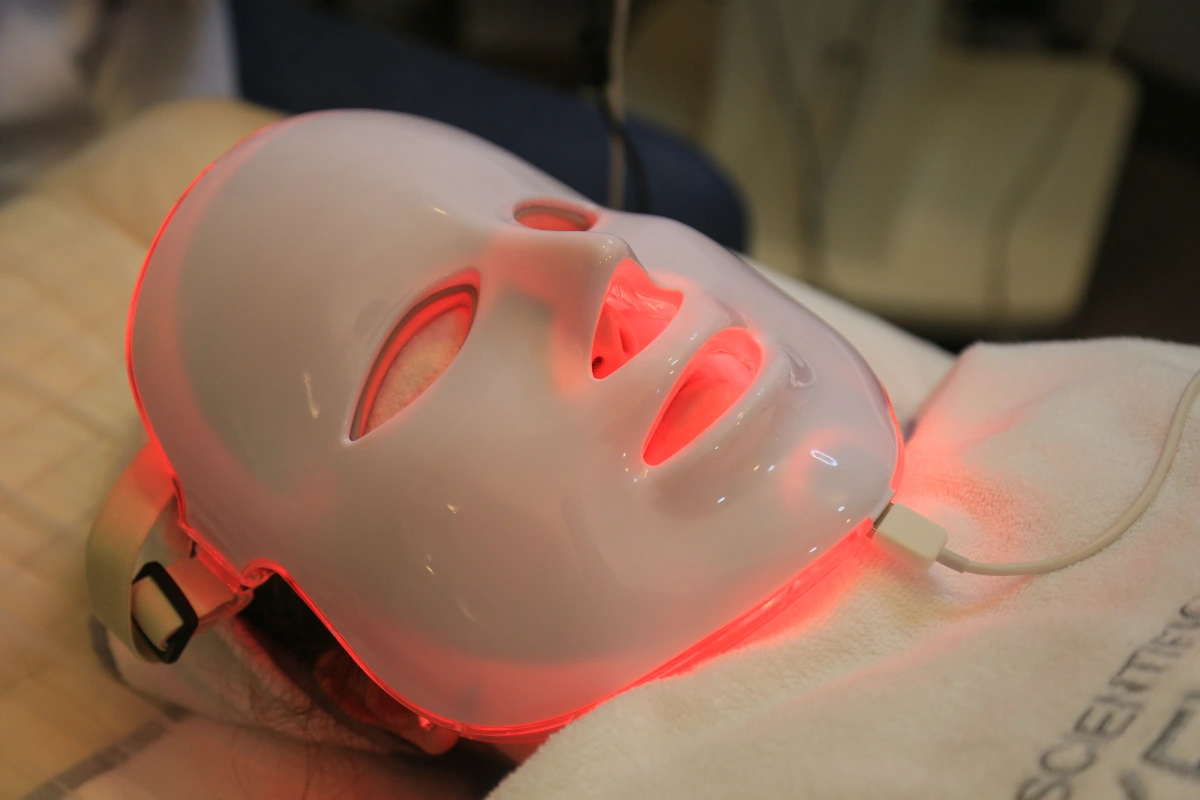
Face masks differ from panels in that the light is delivered very close to the skin through a fixed LED array. The result depends not only on 630–660 nm wavelengths, but also on diode density, how well the mask fits, dose consistency, eye protection, and whether the light reaches the cheeks, forehead, and jawline evenly.
Mask design, diode density, and light distribution across the face
The effectiveness of a red light therapy mask depends not only on the stated wavelength, but also on how the light physically reaches the skin. Rigid masks often maintain a more consistent distance between the LED diodes and the face, but they may conform less well to the nose, jaw, or temple areas. Flexible silicone masks follow the contours of the face more closely, but the angle of their diodes may change, so light distribution is not always uniform.
Diode density determines the continuity of illumination: the larger the gaps between LED points, the more pronounced the “hot” and under-illuminated zones become. In dermatological practice, what matters is not only the number of diodes, but also irradiance uniformity in mW/cm² across different areas of the face. The cheeks often receive a higher dose than the sides of the nose or the area around the lips, so it is worth assessing a mask as an optical system, not merely as a cosmetic device.
How does contact with the skin change the actual dose?
Fit directly changes the actual irradiance, because LED light weakens as distance increases and the angle of incidence changes. If the mask lifts away from the cheeks or forehead by a few millimeters, some photons scatter to the sides, and the skin receives a lower mW/cm² dose than stated in the technical specifications. Light reaches the nostril wings, the curve of the chin, and the area around the eyes especially unevenly.
Dermatologists evaluate not only session duration, but also energy density in J/cm², which depends on irradiance intensity and time. A mask that is placed too loosely may lead the user to lengthen treatments, although this does not necessarily compensate for uneven distribution. Excessive pressure is not ideal either: it can irritate the skin, promote redness, or leave pressure marks, especially on sensitive or rosacea-prone skin.
A better choice is often adjustable straps and clearly defined support zones that allow stable but not aggressive contact to be maintained.
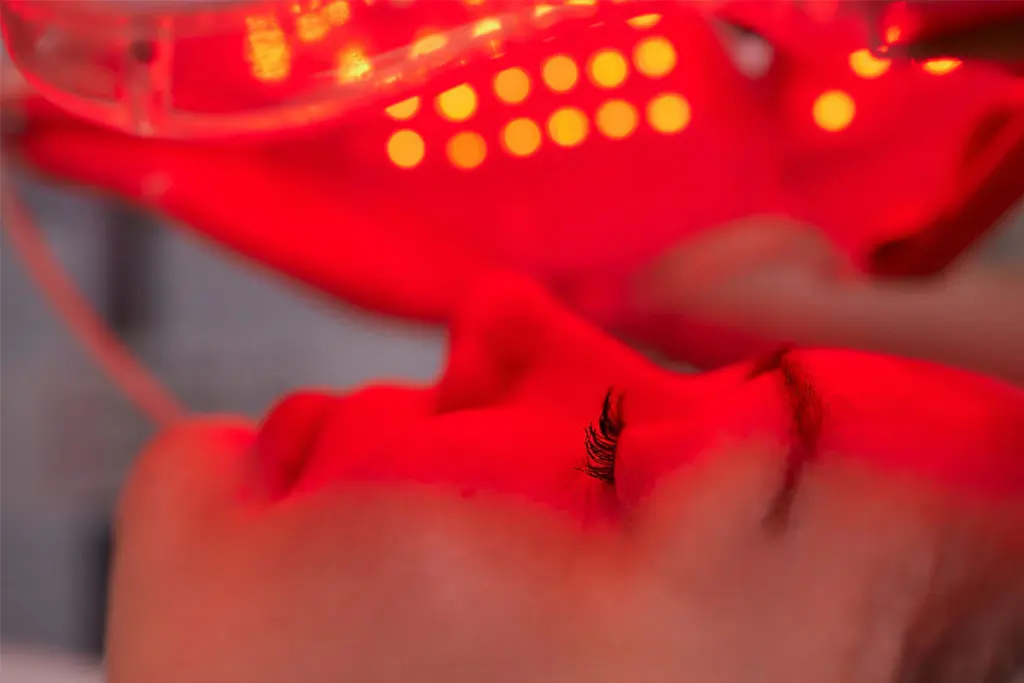
What significance do 630–660 nm wavelengths have for facial skin?
The 630–660 nm red light range is valued for its ability to reach the epidermis and the upper part of the dermis, where many processes related to skin texture, redness, and recovery take place. Photobiomodulation studies often mention the activation of cytochrome c oxidase in the mitochondria: this may affect cellular energy metabolism, collagen synthesis signaling, and the balance of inflammatory mediators. 630 nm light generally acts more superficially, while 660 nm may penetrate slightly deeper, which is why these wavelengths are often combined in practice.
Dermatologists emphasize that wavelength alone does not guarantee results. If a device claims 633 nm but has low irradiance or an uneven light field, the biological effect may be weak. For facial skin, what matters is not aggressive stimulation, but repeated, precisely dosed light, especially when the goal is to reduce the appearance of fine lines, support barrier recovery, or soothe skin irritated after procedures.
Eye protection and the effects of close-range light on sensitive areas
The eye area receives a different light load than the cheeks or forehead because the skin here is thinner and the distance to the retina is short. Although 630–660 nm red light is not as energetic as blue or ultraviolet light, ophthalmologists are cautious about direct LED light entering the eyes, especially when treatments are repeated frequently. Closing the eyes reduces discomfort, but the eyelids are not equivalent to optical protection.
More reliable masks have integrated eye shields, soft seals, or recommend using special protective goggles. It is important that the protection not only covers the eye, but also limits light entering from the sides (this is relevant for flexible masks, which can shift). If flickering, pressure in the eyes, headache, or increased sensitivity to light is felt during the procedure, it is worth stopping the session and assessing the device’s fit and intensity.
Who may not be suited to a red light therapy mask?
A red light therapy mask is not universal, especially if the skin or eyes react sensitively to light. Caution is needed for people taking photosensitizing medications, for example certain retinoids, tetracycline-class antibiotics, or anti-inflammatory medicines. Dermatologists also recommend consulting a professional before use in cases of active dermatoses, severe rosacea, recent burns, open wounds, or after aggressive procedures when the skin barrier has not yet recovered.
A separate group includes people with eye diseases, migraine with light sensitivity, or epilepsy triggered by flickering. Although high-quality LED devices should operate steadily, cheaper models may have pulsation that is not always stated in the technical descriptions. In cases of pregnancy, cancer, or immunosuppression, the decision should be individualized and discussed with a doctor, because safety data for home devices in these groups are often limited.
How to evaluate a mask before buying and using it at home?
When evaluating a mask, it is worth looking not only at the number of LEDs, but also for clear technical data: wavelength tolerance, irradiance in mW/cm², recommended energy density in J/cm², and testing distance. More reliable manufacturers indicate how the intensity was measured, whether the device has an automatic timer, overheating control, and whether the LED field was tested in different facial zones. If only a “red light” description is provided without numbers, such a device is difficult to dose safely.
Before using it at home, dermatologists advise performing a short trial session on a lower setting and monitoring the skin’s reaction for 24 hours. The mask should stay stable, should not press on the bridge of the nose or under-eye area, and the eye protection should remain in place throughout the entire procedure. It is worth keeping a simple usage log: duration, frequency, skin sensations, redness, dryness. This helps distinguish genuine tolerance from overuse.
Conscious use and precise dosing determine whether a red light therapy mask will be beneficial, rather than merely appealing as a home device. From a dermatologist’s perspective, it is worth evaluating the entire system: wavelength, irradiance, fit, eye protection, skin tolerance, and the clarity of the data provided by the manufacturer. A well-chosen mask should work steadily, evenly, and without irritation, while any redness, eye discomfort, or increase in sensitivity is a signal to adjust the regimen or consult a specialist.